

Searching for “hvac companies near me” on your phone during a Florida heat wave is a situation no homeowner wants to face, but knowing how to choose the right contractor before an emergency strikes can save you thousands of dollars and countless headaches. Whether your AC system finally gave out during August humidity, you’re planning a system upgrade, or you simply want to establish a relationship with a trustworthy local contractor, the decision you make will impact your home comfort, energy bills, and indoor air quality for years to come. In Southwest Florida’s unique climate, where air conditioning runs nearly year-round and salt air accelerates equipment wear, selecting the right HVAC company is not just about price but about finding experienced professionals who understand regional challenges and stand behind their work.
Quick Answer: HVAC companies near me are local heating and air conditioning contractors who install, repair, and maintain residential climate control systems. The best companies hold valid Florida state licenses, carry proper insurance, offer transparent pricing, and specialize in the specific climate challenges of your area. Most reputable contractors provide free estimates, emergency service options, and manufacturer-backed warranties on equipment and labor.
What Makes a Good HVAC Company in Florida?
Not all HVAC contractors are created equal, especially in Florida’s demanding climate. A good HVAC company combines technical expertise, proper licensing, and customer service that goes beyond simply fixing equipment. The best contractors understand that Florida homes face unique challenges including extreme humidity, salt air corrosion near coastal areas, frequent thunderstorms, and cooling systems that operate ten to twelve months per year instead of seasonally.
First and foremost, any HVAC company you consider must hold a valid Florida state contractor license. A state-certified HVAC contractor has passed rigorous examinations, demonstrated knowledge of building codes, and maintains required continuing education. Additionally, proper insurance coverage protects you from liability if a technician is injured on your property or if installation errors cause damage to your home.
Furthermore, experience with Florida-specific issues matters tremendously. Contractors familiar with North Port, Port Charlotte, Sarasota, Venice, Punta Gorda, Englewood, Nokomis, Osprey, and Laurel understand that coastal humidity requires different system sizing and dehumidification strategies than inland areas. They also know which equipment brands hold up best in salt air and how to protect outdoor units during hurricane season.
Quality companies also invest in ongoing training for their technicians. HVAC technology evolves rapidly, with new refrigerants, smart thermostats, and high-efficiency systems entering the market constantly. Moreover, top contractors maintain relationships with multiple equipment manufacturers, giving you options rather than pushing a single brand regardless of your needs.
8 Essential Questions to Ask HVAC Companies Near Me
When you contact potential contractors, asking the right questions helps you separate professionals from amateurs. These eight questions reveal critical information about reliability, expertise, and business practices that directly affect your experience and results.
1. What Licenses and Certifications Do You Hold?
Every HVAC contractor in Florida must hold either a state-certified or registered license to legally perform installation and repair work. A state-certified contractor has met higher requirements and can work anywhere in Florida, while registered contractors work under a certified contractor’s supervision. Additionally, ask about technician certifications such as NATE (North American Technician Excellence) certification, which demonstrates advanced technical knowledge. Insurance coverage should include both general liability and workers’ compensation to protect you from potential claims.
2. How Long Have You Been Serving This Specific Area?
Local experience matters significantly in HVAC work. Contractors who have operated in Southwest Florida for five years or longer understand regional building codes, common home construction types, and climate-specific challenges. They also have established reputations that you can verify through local references. In contrast, newer companies or those from outside the area may not understand that coastal homes require additional corrosion protection or that older Venice and Englewood properties often need ductwork modifications.
3. Can You Provide References from Recent Jobs?
Reputable contractors readily provide references from customers who have had similar work completed within the past year. Ask specifically for references from homeowners in your city, whether that’s Punta Gorda, Port Charlotte, Sarasota, or another local community. When you contact references, ask about punctuality, cleanliness, how the company handled unexpected issues, and whether the system performs as promised. A pattern of satisfied local customers indicates consistent quality and reliability.
4. What Brands Do You Install and Why?
Quality contractors work with multiple equipment manufacturers and can explain the pros and cons of each brand honestly. Be wary of companies that only install one brand or push the most expensive option without discussing your specific needs. For example, some brands offer better warranties, while others excel in energy efficiency or perform better in Florida’s salt air environment. The contractor should ask about your priorities such as upfront cost, long-term efficiency, or quiet operation before recommending equipment.
5. How Do You Size HVAC Systems?
Proper system sizing is critical in Florida’s climate, yet many contractors still use outdated rules of thumb instead of performing detailed calculations. Professional contractors perform a Manual J load calculation, which accounts for your home’s square footage, insulation levels, window types, orientation, and typical occupancy patterns. Oversized systems cycle on and off too frequently, failing to remove humidity and wasting energy. Undersized systems run constantly, struggling to maintain comfort during peak summer heat. Therefore, insist on documentation of the load calculation for any new installation.
6. What Does Your Warranty Cover?
HVAC warranties typically include two components: manufacturer equipment warranties and contractor labor warranties. Manufacturer warranties on new equipment typically range from five to ten years on major components, but registration requirements and coverage details vary significantly between brands. Additionally, labor warranties cover the cost of returning to fix installation-related issues and typically range from one to five years. The best companies offer extended labor warranties because they’re confident in their installation quality. Always get warranty terms in writing before work begins.
7. Do You Offer Emergency Service?
Air conditioning failures don’t follow business hours, and in Florida’s heat, a broken AC becomes an emergency quickly. Ask whether the company offers after-hours, weekend, and holiday emergency service. Also inquire about response times and emergency service fees. Some contractors offer emergency service but charge premium rates that can be two to three times normal pricing. Others include emergency service as a benefit for maintenance agreement customers. If you’re looking for a long-term HVAC partner, emergency availability is essential, and you can learn more about what to expect in our 24 7 Emergency HVAC: What Florida Homeowners Need to Know guide.
8. What Financing Options Do You Offer?
HVAC system replacement represents a significant investment, typically ranging from $5,000 to $15,000 or more depending on system size and features. Many homeowners need financing to spread costs over time. Reputable contractors offer multiple financing options with clear terms, including promotional zero-interest periods for qualified buyers. However, read financing agreements carefully, as deferred interest plans can result in high charges if not paid off within the promotional period. Transparent contractors explain all financing terms upfront without pressure.
How to Verify HVAC Contractor Credentials
Once you’ve asked the right questions, verifying credentials protects you from unlicensed or fraudulent contractors. Florida makes it relatively easy to check contractor licensing and complaint history through official state resources.
Start by checking the contractor’s license through the Florida Department of Business and Professional Regulation website. You can search by company name or license number to verify that the license is active, view the license classification, check the expiration date, and see any disciplinary actions. A contractor operating with an expired or suspended license puts you at serious legal and financial risk, as work performed may not meet code and insurance may not cover problems.
Next, verify insurance coverage by requesting certificates of insurance directly from the contractor. The certificate should list both general liability coverage and workers’ compensation insurance with current effective dates. Moreover, you can contact the insurance companies listed to confirm the policies are active. This step is crucial because if an uninsured worker is injured on your property, you could face a lawsuit.
Check the Better Business Bureau rating and read customer reviews, but interpret them carefully. Look for patterns rather than focusing on individual complaints, since even excellent companies occasionally have dissatisfied customers. Pay particular attention to how the company responds to negative reviews. Professional contractors address complaints constructively and work to resolve issues, while poor-quality companies ignore criticism or respond defensively.
Additionally, verify membership in professional organizations such as the Air Conditioning Contractors of America (ACCA). Membership doesn’t guarantee quality, but it indicates the contractor invests in staying current with industry standards and best practices. Similarly, factory certification from major equipment manufacturers demonstrates commitment to proper installation techniques.
According to the U.S. Department of Energy, proper installation is just as important as equipment efficiency when it comes to system performance, making contractor credentials a critical factor in long-term satisfaction and energy costs.
Common Mistakes When Choosing HVAC Companies Near Me
Even informed homeowners sometimes make critical mistakes when selecting contractors. Avoiding these common errors saves money, frustration, and potential safety issues.
The biggest mistake is choosing based solely on price. While budget matters, the lowest bid often indicates corner-cutting, inferior equipment, or improper sizing that costs more in the long run through higher energy bills and premature system failure. Instead, compare value by evaluating experience, warranties, equipment quality, and included services alongside price.
Another common error is failing to get multiple estimates. A single estimate provides no context for whether pricing is reasonable or whether the proposed solution is appropriate. Most experts recommend obtaining at least three detailed written estimates from licensed contractors. However, more than five estimates typically wastes time without adding useful information.
Many homeowners also fail to verify that estimates include the same scope of work and equipment quality. One contractor might propose a basic 14 SEER system while another quotes a 16 SEER model with advanced features. Unless you carefully compare specifications, you might think you’re getting a deal when you’re actually receiving inferior equipment. Ensure all estimates specify equipment model numbers, SEER ratings, warranty terms, and exactly what installation work is included.
Ignoring red flags costs homeowners significantly. Be wary of contractors who demand large deposits before starting work, refuse to provide written estimates, can’t provide proof of licensing and insurance, or pressure you to make immediate decisions. Similarly, avoid contractors who arrive in unmarked vehicles without company branding, as this often indicates unlicensed operators working on the side.
Furthermore, many homeowners overlook the importance of a detailed written contract. Every HVAC project should include a contract specifying equipment models and specifications, total cost with payment schedule, project timeline, warranty information, and cleanup responsibilities. Verbal agreements or handshake deals leave you vulnerable if problems arise.
Finally, some homeowners hire contractors based solely on personal relationships without verifying credentials. While a neighbor’s recommendation provides valuable insight, you must still verify licensing, insurance, and get written estimates. Even well-meaning friends and family can unknowingly recommend unlicensed contractors who seem nice but lack proper training and legal protections.
What to Expect from Professional HVAC Service
Understanding what professional service looks like helps you evaluate contractors during initial consultations and throughout your relationship. Quality HVAC companies follow consistent processes that demonstrate expertise and professionalism.
A proper service call begins with clear communication. The company should provide arrival time windows and call ahead when the technician is en route. The technician should arrive in a clearly marked company vehicle, wear a uniform with identification, and introduce themselves professionally. These details indicate an established, legitimate business rather than an unlicensed operator.
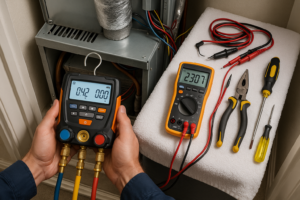
During system evaluation, professional technicians perform comprehensive diagnostics rather than jumping to conclusions. For example, if your AC isn’t cooling properly, thorough diagnosis includes checking refrigerant levels, testing electrical components, inspecting ductwork, evaluating airflow, and measuring temperature differentials. Only after completing diagnostics should the technician explain the problem and propose solutions.
Quality contractors provide transparent, detailed estimates before performing work. The estimate should specify the problem identified, proposed solution, parts required with model numbers, labor costs, and total price. Additionally, good contractors explain multiple options when available, from budget-friendly basic repairs to more comprehensive solutions, letting you make informed decisions based on your priorities.
During installation or repair work, professional contractors protect your home. They use drop cloths to protect floors, wear shoe covers inside, and clean up thoroughly when finished. Installation work should meet manufacturer specifications and local building codes. Moreover, technicians should test systems thoroughly after completion and walk you through operation, maintenance requirements, and warranty information.
After service, expect follow-up. Quality companies contact you within a few days to ensure the system is operating properly and you’re satisfied with the work. They also provide clear invoices detailing all work performed and stand behind their service if issues arise.
How Much Does HVAC Service Cost in Southwest Florida?
Understanding typical costs helps you budget appropriately and recognize whether estimates are reasonable. HVAC pricing varies based on service type, system size, equipment quality, and project complexity, but general ranges apply across North Port, Port Charlotte, Sarasota, Venice, Punta Gorda, Englewood, Nokomis, Osprey, and Laurel.
Routine maintenance visits typically cost between $89 and $200 per visit. These tune-ups include cleaning, inspection, filter replacement, and minor adjustments. Many companies offer annual maintenance agreements that include two visits per year at a discounted rate, typically ranging from $150 to $300 annually. Maintenance agreements often include additional benefits such as priority scheduling and discounts on repairs.
Diagnostic service calls generally cost $75 to $150, which covers a technician’s visit to identify problems. Many companies waive this fee if you proceed with recommended repairs. However, be cautious of companies offering free service calls, as they may inflate repair prices to compensate.
Repair costs vary dramatically depending on the issue. Simple repairs such as replacing a capacitor or contactor typically cost $150 to $400. More complex repairs like replacing a compressor or air handler motor range from $800 to $2,500. If refrigerant needs to be added, expect to pay $50 to $150 per pound, though properly functioning systems should not need refrigerant added regularly since AC systems don’t consume refrigerant.
Complete system replacement represents the largest expense. In Southwest Florida, residential AC installation typically costs $5,000 to $15,000 depending on system size, efficiency rating, and installation complexity. Basic 2-ton to 3-ton systems with standard efficiency fall at the lower end, while larger 4-ton to 5-ton high-efficiency systems with advanced features reach the higher range. Additionally, homes requiring ductwork modifications, electrical upgrades, or structural changes to accommodate equipment incur additional costs.
Several factors influence pricing beyond basic labor and equipment. Coastal properties in areas like Englewood and Venice may need additional corrosion protection, adding $500 to $1,500 to installation costs. Older homes with outdated electrical systems might require panel upgrades. Furthermore, two-story homes, properties with difficult attic access, or unique architectural features typically cost more due to installation complexity.
When comparing estimates, ensure you’re comparing equivalent equipment and services. A quote that seems unusually low may reflect cheaper equipment, shorter warranties, or exclusion of necessary components such as permits, drain line modifications, or thermostat upgrades.
Why Local Experience Matters for HVAC Service
While national chains and franchises operate in Southwest Florida, local independent contractors often provide advantages that larger companies cannot match. Understanding these differences helps you weigh options when evaluating companies.
Local contractors understand regional climate and construction. Companies that have operated in North Port, Port Charlotte, and surrounding areas for years know that coastal homes face salt air corrosion, that older Venice properties often have undersized ductwork, and that proper dehumidification matters as much as temperature control in Florida’s humidity. This regional expertise leads to better system design and fewer callbacks.
Additionally, local businesses typically have stronger community accountability. Your contractor lives in the same community, shops at the same stores, and cares about local reputation. This creates natural incentive to provide excellent service since word-of-mouth referrals drive their business. In contrast, technicians from distant corporate offices may never return to the area and have less personal stake in your satisfaction.
Response times often favor local companies, especially for emergency service. A company based in Punta Gorda can reach customers in nearby Port Charlotte or Englewood within 30 to 60 minutes, while regional offices of national chains might be hours away. During peak seasons when AC failures spike, local contractors prioritize existing customers in their service area.
Furthermore, local businesses provide continuity. When you call, you speak with people who remember your home, your system, and your service history. This relationship allows for better service and often results in technicians spotting small issues before they become major problems. The same technician may service your system year after year, becoming familiar with its quirks and history.
Local contractors also tend to be more flexible with scheduling and service customization. While national companies often follow rigid corporate policies, independent businesses can adapt to unusual situations, work with your schedule, and customize solutions to your specific needs and budget.
Frequently Asked Questions About HVAC Companies Near Me
What should I look for when searching for HVAC companies near me?
When searching for HVAC companies near me, prioritize contractors with valid Florida state licenses, comprehensive insurance coverage, and several years of experience serving your specific area. Check online reviews, verify credentials through the Florida Department of Business and Professional Regulation, and ensure the company offers written estimates, clear warranties, and emergency service options.
How many estimates should I get for HVAC work?
Homeowners should obtain at least three written estimates from licensed HVAC contractors before making a decision. Three estimates provide enough comparison points to identify fair market pricing and evaluate different approaches to your project without overwhelming you with too many options. Ensure all estimates include identical scope of work, equipment specifications, and warranty terms to make meaningful comparisons.
Are HVAC companies near me in Port Charlotte licensed differently than those in Sarasota?
No, HVAC licensing requirements are consistent throughout Florida under state law. State-certified HVAC contractors can work anywhere in Florida, including Port Charlotte, Sarasota, North Port, Venice, Punta Gorda, Englewood, Nokomis, Osprey, and Laurel. However, some jurisdictions have additional permitting requirements, so contractors should be familiar with local building departments in the areas they serve.
What is a Manual J load calculation and why does it matter?
A Manual J load calculation is a detailed engineering process that determines the correct HVAC system size for a specific home by accounting for square footage, insulation levels, window efficiency, orientation, and climate zone. Proper load calculations prevent oversized systems that waste energy and fail to control humidity, as well as undersized systems that cannot maintain comfort during peak temperatures.
How much does emergency HVAC service cost in Southwest Florida?
Emergency HVAC service in Southwest Florida typically costs 1.5 to 3 times regular service rates, with after-hours service calls ranging from $150 to $300 just for the visit, plus parts and labor. Some companies offer flat-rate emergency pricing while others charge time-and-materials rates. Maintenance agreement customers often receive discounted or free emergency service calls even during nights, weekends, and holidays.
What is the difference between a state-certified and registered HVAC contractor?
A state-certified HVAC contractor has passed comprehensive state examinations, demonstrated extensive experience, and can work independently anywhere in Florida. A registered contractor works under the supervision of a state-certified contractor and has more limited authority. For major projects such as system replacement, homeowners should work directly with state-certified contractors who hold unrestricted licenses.
How often should I have my HVAC system serviced in Florida?
HVAC systems in Florida should be professionally serviced twice per year, typically once before summer cooling season and once before winter. Florida’s year-round system operation, high humidity, and dusty conditions create more wear than in seasonal climates, making biannual maintenance essential for efficiency, reliability, and warranty compliance.
Is it worth paying more for a highly-rated HVAC company?
Paying moderately more for a highly-rated, properly licensed HVAC company is almost always worthwhile because installation quality dramatically affects long-term system performance, efficiency, and lifespan. A properly installed $7,000 system will outperform and outlast a poorly installed $5,500 system, ultimately saving money through lower energy bills, fewer repairs, and extended equipment life.
What certifications should HVAC technicians have?
HVAC technicians should hold EPA Section 608 certification for refrigerant handling, which is federally required. Additionally, NATE (North American Technician Excellence) certification demonstrates advanced technical competency, though it is not legally required. Manufacturer certifications for specific equipment brands indicate specialized training for proper installation and service of those systems.
Can I negotiate HVAC installation prices?
HVAC installation prices are sometimes negotiable, particularly during slower seasons such as spring and fall when contractors have more availability. However, focus negotiations on value-added items such as extended warranties, free maintenance visits, or upgraded thermostats rather than just reducing price, which may incentivize corner-cutting. Quality contractors have fixed labor rates and equipment costs but may offer package deals or promotional pricing.
Trust Manasota Cooling & Heating for Expert HVAC Service
When you search for “hvac companies near me” in Southwest Florida, you need more than just any contractor. You need a team that understands the unique challenges of our coastal climate, holds proper licensing and insurance, and treats your home with the respect it deserves. Manasota Cooling & Heating has served North Port, Port Charlotte, Sarasota, Venice, Punta Gorda, Englewood, Nokomis, Osprey, and Laurel for years with honest, reliable HVAC service backed by transparent pricing and workmanship you can count on.
Our state-certified technicians provide comprehensive services from routine maintenance and emergency repairs to complete system installations and indoor air quality solutions. We offer upfront pricing, multiple equipment options to fit every budget, and warranties that protect your investment. Whether you need immediate emergency service or want to schedule a system evaluation, our team is ready to help you stay comfortable year-round. Contact Manasota Cooling & Heating today at (941) 225-2335 or visit our website to schedule your service and experience the difference that local expertise and genuine customer care make in HVAC service.